
Colin Graham (Robeco) || The possibility of interest rates rising amid geopolitical instability could turn this market, largely below IG, into a kind of wild west, similar to what was experienced during the Global Financial Crisis (GFC) and the subprime mortgage debacle that preceded it.
«Private credit encompasses direct loans and intermediate market loans, where the capital is provided by non-bank lenders, meaning it does not appear on bank balance sheets, which were subject to stricter regulation following the Global Financial Crisis of 2008», says Graham, head of the Multi-Asset team at Robeco Investment Solutions.
«The business of off-balance sheet lending grew after the GFC and the subsequent US Dodd-Frank law to protect bank depositors. The question for investors is whether the private credit market, at USD 2.1 trillion, now poses a threat, as rates have risen and geopolitical concerns, such as the Iran conflict, threaten financial stability».
Structural stress test
Most private credit loans are below IG, due to their nature of lending to companies with lower credit ratings and less ability to access public debt markets, giving them a channel to borrow money.
«This provides lenders and investors with higher returns and lower volatility (a better Sharpe ratio)», says Graham. «The downside for private credit investors is that valuations can be opaque and, in the event of financial or economic crises, the benefits of diversification evaporate, as the correlation with conventional credit markets returns to one. The main concern focuses on capital returns, more than on returns on capital, trying to avoid defaults at all costs».
«Credit markets remained solid as a rock in 2025, but towards the end of the year, a divergence began to show between listed (public) markets and unlisted (private) markets. While public IG markets continue to hold up, the private credit market, at USD 2.1 trillion, began to undergo a structural stress test».
Exposure to high technology
One of the issues is that private credit has a much greater exposure to the technology sector—which is vulnerable to AI disruption—than public debt. Although private credit does not trade with the same regularity as listed credit or equities, the significant common exposure to technology means that the benefits of lower volatility can be dispersed.
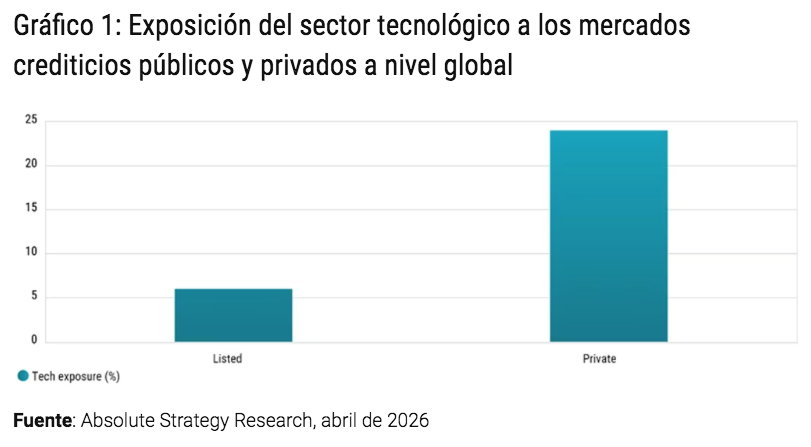
«Now this giant market is facing difficulties», warns Graham. «The conjunction of a higher interest rate environment, the geopolitical crisis stemming from the Gulf conflict, and tariffs, along with the disruption of business models in the software sector driven by AI, has created a period of increased scrutiny».
«We believe that official default rates (currently around 2.1%) are a lagging indicator. When considering liability management (LME) and hidden difficulties, the “real” rate approaches 5.4%».
«In this context, the divergence in returns between tangible assets with low obsolescence (HALO - Hard Assets, Low Obsolescence), based on physical infrastructure, and highly leveraged software portfolios exposed to artificial intelligence becomes evident».
Inflation = higher rates
And now, the outbreak of war in Iran has caused another jolt in oil prices and supply chain disruptions, bringing with it the inevitable inflationary pressures last seen during the COVID-19 pandemic. Higher inflation will make it more likely that rates will rise to counter it, which poses a direct threat to highly leveraged companies.
«Our investment scenario for 2026 outlined a positive macroeconomic context, although the probability of a downside scenario has increased since then due to the Gulf supply chain impediments», says Graham. «The difficulties have been escalating, which has significant repercussions for borrowing companies and private credit investors».
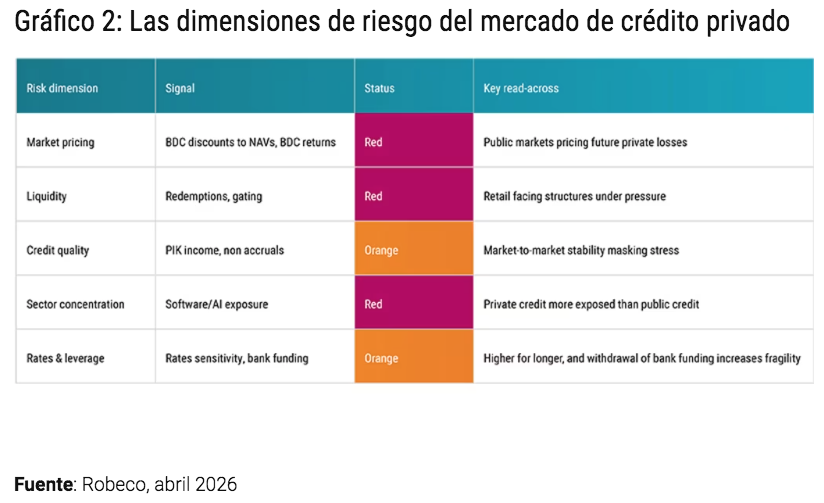
«Firstly, the escalation of the conflict in the Middle East has led to the closure of the Strait of Hormuz, which could trigger a global supply crisis unprecedented since the COVID-19 lockdowns. Secondly, expectations about rates have shifted from pointing to cuts to pointing to increases, as inflationary pressures are expected to rise. Finally, AI is considered a factor jeopardising business models in sectors such as software and IT services, complicating the pricing of “exit” for companies».
Haven't we been through this already?
Are we, therefore, facing a repetition of the global financial crisis, when defaults on loans rated below IG were about to sink the banking system? «The growth of private credit has been driven by a loose monetary policy (leverage) and by investors' search for yield, which has meant that demand has driven supply and reduced credit granting criteria», says Graham.
«The US SEC indicated in 2024 that advisors find themselves in a conflict of interest situation with private funds and their investors when valuing fund assets and using those valuations as a basis for calculating their fees and fund returns».
«This is reminiscent of the remuneration structure of mortgage appraisers and rating agencies for collateralised loan obligations (CLOs) before the GFC highlighted the dangers of this business model».
A deadlock…
The true test of stability will take place in the next 18 months, when nearly USD 480 billion in private debt matures and promoters, investors, and borrowers decide who will take care of the repayment or refinancing.
«Much of this private credit was granted in the early part of the decade, with valuations and interest rates that no longer exist», says Graham. «Without a solid market for IPOs or mergers and acquisitions, these “capital gaps” will need to be filled through aggressive capital injections by sponsors or through debt-for-equity swaps, which will redefine the recovery landscape».
«Although the banking system may be protected, there are other players in the financial sector that hold a larger amount of private credit, such as life insurers, who could be more vulnerable to amortisations».
…or an irrefutable test?
«The private credit market is not facing an imminent collapse, but rather is in a phase of the cycle where it is maturing and becoming more fragile». New waves of private credit investors should be able to navigate the mentioned obstacles, as rates have normalised and the economy is experiencing instability, making it less likely that lenders will pay too much for a company. Current debt holders may face a bumpier road».
«Looking ahead, institutional investors with longer time horizons should avoid access issues, while benefiting from the illiquidity premium and opportunities arising from forced liquidations, restructurings, and refinancings».
«We anticipate that 2026 and 2027 will be the years in which returns will be generated through restructuring experience and rigorous manager selection by financially capable sponsors, at the expense of retail and minority lenders. We continue to analyse the prospects for private credit».


